
How Product Q&A Landing Pages Improve Google Search Rankings and AI Visibility: A Best Buy Example
When shoppers research products, they frequently search Google using highly specific questions.
For example:
- How wide are the TV stand legs for a TCL 85-inch TV?
- Is this replacement part compatible with my equipment?
- Can this product be used outdoors?
- What's the difference between these two models?
These questions represent valuable search demand from shoppers who are researching products and making purchasing decisions.
While traditional product detail pages may contain some of this information, they aren't always optimized to rank for every specific question a potential customer might ask.
Individual product Q&A landing pages create dedicated, search-accessible URLs that address these questions directly.
Major retailers such as Best Buy use this approach, and their results provide a useful example of how product Q&A content can gain visibility in both traditional Google Search and AI-generated search experiences.
Real-World Example: Best Buy's Product Q&A Pages
Best Buy publishes individual landing pages for product questions, giving each question its own dedicated URL.
For example, Best Buy has a Q&A landing page addressing the question:
"How wide are the TV stand legs?"
The page provides measurements for the stand positions of a TCL 85-inch television, helping shoppers determine whether the television will fit their furniture.
What Happens When Someone Searches Google?
In the Google Search example below, a shopper searches:
"How wide are the TV stand legs for the TCL 85" TV?"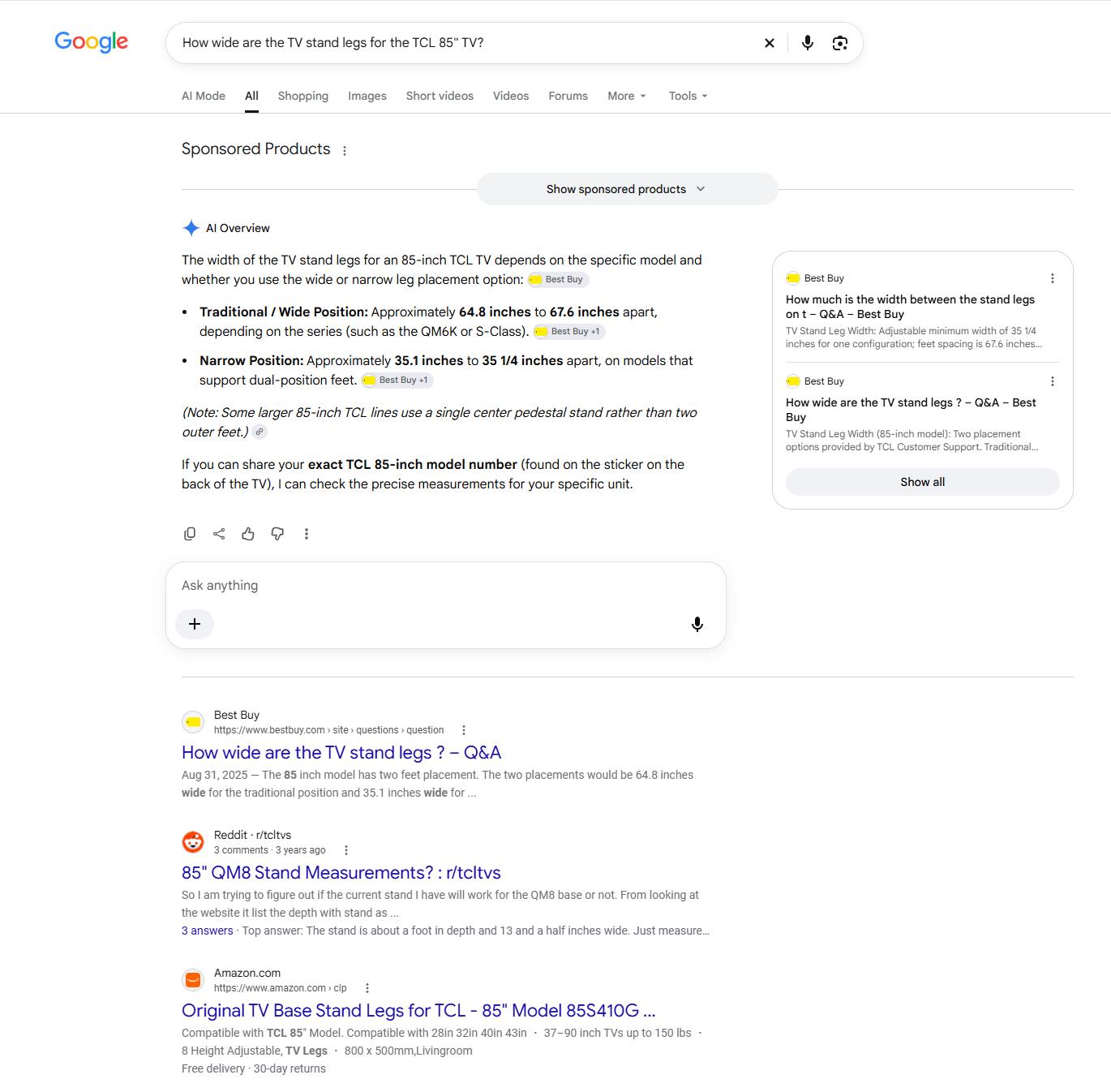
The screenshot demonstrates three important SEO benefits.
1. Individual Q&A Pages Can Rank in Traditional Google Search
Best Buy's individual Q&A landing page appears as the first traditional organic search result for this product-specific question.
Rather than relying exclusively on the main product detail page, Best Buy has a dedicated page that closely matches the shopper's search.
This illustrates how individual Q&A pages can help retailers compete for highly specific, long-tail product searches.
2. Product Q&A Content Can Be Cited in Google's AI Overviews
The same search also triggers a Google AI Overview.
Google's AI-generated response includes information about the television's stand measurements and cites Best Buy as a supporting source.
In fact, the screenshot shows two Best Buy Q&A results in the AI Overview's source panel.
This is especially significant because shoppers increasingly encounter AI-generated answers directly within Google Search.
Product Q&A content can contribute to a retailer's visibility not only through traditional rankings, but also through citations within AI-generated answers.
3. Individual Q&A Pages Create Additional Search Entry Points
Every relevant product question represents a potential opportunity to reach shoppers searching for that information.
A product page might target broader searches such as "TCL 85-inch TV," while individual Q&A pages can address narrower searches about dimensions, compatibility, installation, performance, or specific features.
These dedicated pages give search engines additional opportunities to discover and surface relevant information associated with a merchant's products.
Importantly, publishing a Q&A page doesn't guarantee indexing, rankings, or AI citations. Results depend on content quality, relevance, technical accessibility, and Google's indexing and ranking systems.
How Answerbase Supports This SEO Strategy
Answerbase helps ecommerce merchants implement a similar product Q&A publishing strategy without manually creating and managing individual pages for every customer question.
Identify Questions Shoppers Actually Ask
Answerbase uses customer questions, product information, and Product Knowledge Intelligence (PKI) to identify valuable opportunities for product-specific Q&A content.
This helps merchants prioritize questions based on actual shopper demand and gaps in existing product information.
Generate and Publish Helpful Product Answers
Answerbase helps merchants create relevant answers using available product knowledge and supporting information.
Merchants can review and publish this content, expanding the amount of useful product information available to shoppers.
Create Dedicated, Search-Accessible Q&A Landing Pages
Answerbase supports individual Q&A landing pages that provide dedicated URLs for published product questions.
These pages are designed to make product-specific answers accessible to search engines and give merchants opportunities to appear for relevant long-tail searches.
Proper implementation, including crawlability, canonical URLs, internal linking, and indexing controls, is important to realizing these benefits.
Connect Q&A Content to Product Discovery and Conversion
Answerbase connects published questions and answers to the products they describe, helping shoppers move from researching a question to evaluating the relevant product.
Answerbase also provides engagement and conversion attribution reporting so merchants can better understand how shoppers interact with Q&A content and how that engagement contributes to sales.
Measure Search and AI Visibility
Merchants can use Google Search Console alongside Answerbase reporting to evaluate the performance of their Q&A content.
Relevant metrics include:
- Google Search impressions and clicks associated with Q&A pages.
- Search queries that surface product-specific answers.
- Engagement with published Q&A content.
- Conversions and revenue associated with Q&A engagement.
- Visibility in Google's AI search experiences, where measurable.
These insights help merchants determine which questions provide value and where additional product content may be beneficial.
What Ecommerce Merchants Can Learn From Best Buy
The Best Buy example illustrates an important principle:
Product Q&A isn't just an on-page customer support feature. It can also become a valuable source of search-discoverable product content.
By publishing helpful answers on individual landing pages, merchants can create opportunities to reach shoppers who are asking highly specific questions during their purchasing journey.
Best Buy's example demonstrates that this type of content can appear prominently in traditional Google results and be cited within Google's AI Overviews.
Answerbase makes this strategy accessible to ecommerce merchants by combining product Q&A publishing, demand intelligence, AI-assisted content generation, and performance measurement.
Frequently Asked Questions
Can individual product Q&A pages be indexed by Google?
Yes. Individual product Q&A pages can be indexed when Google can access them and considers them eligible for indexing. Best Buy's Q&A example demonstrates an individual question URL appearing in Google's organic search results.
Can product Q&A pages appear in Google AI Overviews?
Yes. The Best Buy example shows product Q&A content being cited as a supporting source in a Google AI Overview. However, citations are selected by Google and cannot be guaranteed.
Do individual Q&A pages replace product detail pages?
No. Individual Q&A pages complement product detail pages by addressing specific informational searches while connecting shoppers with the relevant products.
Does every product question need its own landing page?
Not necessarily. Merchants should prioritize questions that provide distinct, useful information. Creating large numbers of repetitive or low-value pages can be counterproductive.
How can I measure the SEO impact of product Q&A pages?
Google Search Console can help identify impressions, clicks, queries, and indexing performance. Answerbase provides additional Q&A engagement and conversion attribution data to help evaluate business impact.
Want to improve your product Q&A search visibility?
Answerbase helps ecommerce merchants turn product questions and product knowledge into useful, search-accessible content that supports organic discovery, AI visibility, and conversion.
Visit Answerbase.com to learn more.
